
Separating selection from reconciliation
A discovered image is not a running workload. A reconciled workload is not a verified candidate, and an eligible candidate has not necessarily been promoted. Resilience Gate makes these handoffs visible by giving Kargo, Argo CD, analysis, and the operator separate responsibilities.
Design decision examined. The rendering, reconciliation, and verification changes have repository history attributed to devSatym. This case explains their interaction without claiming to have invented the tools or performed a new promotion.
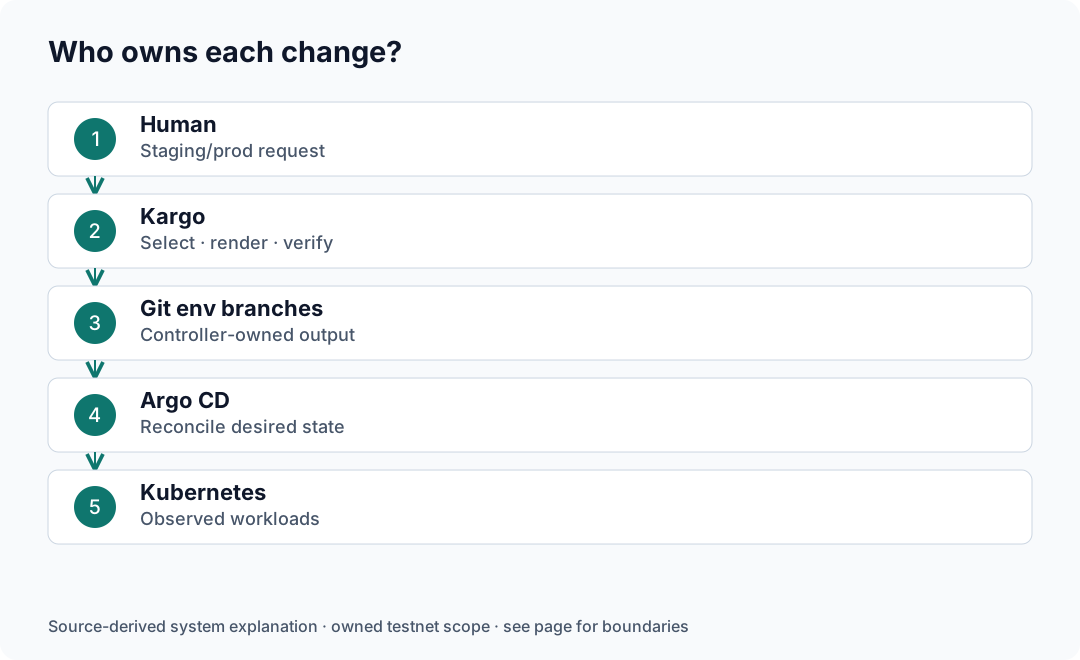
Kargo writes rendered branches and coordinates verification. Argo CD reconciles those outputs to Kubernetes. Human requests control staging and prod promotion.
Source-derived explanation; not a live observation.Read the diagram step by step
- Publication creates immutable candidate material.
- Kargo owns discovery, promotion intent and verification association.
- Argo CD owns reconciliation; the gate owns only its experiment and measurements.
- A successful staging verification grants eligibility; an operator requests prod-like promotion.
Public implementation sources
Carry a candidate rather than a tag
Section titled “Carry a candidate rather than a tag”Kargo’s Warehouse discovers the Git/image material carried by Freight. A stage’s promotion sequence uses that material to render its environment branch. The image is pinned by digest, and the render uses the source revision carried by the same Freight.
The staging sequence clears and renders its output directory, commits the resulting manifests to env/staging, pushes them, and requests Argo CD synchronization to the exact rendered commit. Its verification arguments separately carry release revision and image digest to the gate.
The invariant is selection, rendering, and measurement retain a candidate binding. A moving tag, a later branch HEAD, or a screenshot capture time cannot silently substitute for one of those identities. Application source, chart source, rendered commit, and runtime image may differ while still being explicitly related.
Let Argo CD reconcile the intended render
Section titled “Let Argo CD reconcile the intended render”The ApplicationSet creates applications tracking env/dev, env/staging, and env/prod. Its authorized-stage annotation permits the corresponding Kargo handoff. Argo CD applies the rendered manifests to the selected namespace and reports synchronization/health.
These environment branches are machine-owned outputs. Merging them back into application source would confuse rendered state with the authoring inputs. The desired-revision handoff also makes the exact output reviewable instead of relying on an out-of-Git deployment mutation.
| Owner | Responsibility | Evidence to inspect |
|---|---|---|
| Kargo Freight and promotion | Select source/image material and render the stage | Freight, source/digest, promotion output commit |
| Argo CD | Reconcile the rendered revision | Application revision, synchronization, health |
| Verification analysis | Execute the stage’s required checks | AnalysisRun, Job, scorecards, cleanup outcome |
| Operator | Request protected downstream movement | Explicit promotion record and selected Freight |
Argo health is useful reconciliation evidence; it cannot replace the staging fault hypothesis. A dashboard is useful observation; it cannot replace the enclosing analysis.
Verification supplies eligibility, not an automatic production-like move
Section titled “Verification supplies eligibility, not an automatic production-like move”The Project policy permits automatic development promotion, while staging and prod remain manual. Staging requests Freight from development and references both service health and the immutable Job-backed chaos gate. Production-like testnet requests staging Freight and performs post-deploy readiness/liveness checks.
Normal staging verification supplies downstream eligibility. A protected promotion still requires an explicit request; a manual approval override is a different action and cannot be cited as proof that the normal gate passed. After promotion, the downstream render and health outcome have their own records.
The production-like template does not rerun the full paid staging chaos exercise. A successful prod health smoke therefore cannot be described as another successful Redis/PostgreSQL/signer fault campaign or public-production qualification.
Implementation and test history
Section titled “Implementation and test history”Commit 20836e01 introduces Freight-bound development rendering and the exact-commit reconciliation handoff. Commit 5e3a2971 adds scoped ApplicationSet/AppProject resources. Commit 3d79523d connects staging to the immutable bounded chaos Job.
The final pinned manifests include later Kargo API corrections. Historical diffs explain implementation evolution; the promotion contract tests and current manifests establish the inspected configuration. This case does not run bootstrap, reconciliation, or promotion.
Read the recorded campaign across its handoffs
Section titled “Read the recorded campaign across its handoffs”The 3 October report records staging analysis from 14:37:29Z to 14:46:28Z, followed by a separately authorized production-like testnet promotion and health analysis from 15:34:59Z to 15:35:29Z. Both stages use the recorded Freight d3b4380d40e87e244162da80aae9eb90503be15d; the report retains different rendered revisions and analysis identities.
That is a historical result for the named owned-lab campaign. The later v1.1.0 source/governance release is not another promotion run, and the retired lab is not a live service-status feed.
The next review question is which exact record proves each handoff, rather than whether one screen looks green. Release journey follows the complete candidate; cleanup and final outcome explains why a scorecard alone is insufficient.
Maintained by Satyam Agnihotri · DevOps & Cloud Engineer