
DECISION 01
When missing telemetry must block a release
How can an empty query avoid becoming a healthy zero?
Validate the returned samples and the query contract before applying a threshold.
Read the engineering caseRELEASE ENGINEERING / OWNED TESTNET
A healthy deployment is the beginning. Follow one candidate through useful traffic, controlled failures, recovery, and the evidence behind its next step.
A documented lab, with bounded claims. No live status feed.
THE RELEASE QUESTION
The application creates short URLs, optionally through an x402 payment. The release platform asks whether this exact candidate can do useful work, tolerate the tested failures, recover, and leave its experiment clean. Source, image, rendered revision and run identity connect those decisions.
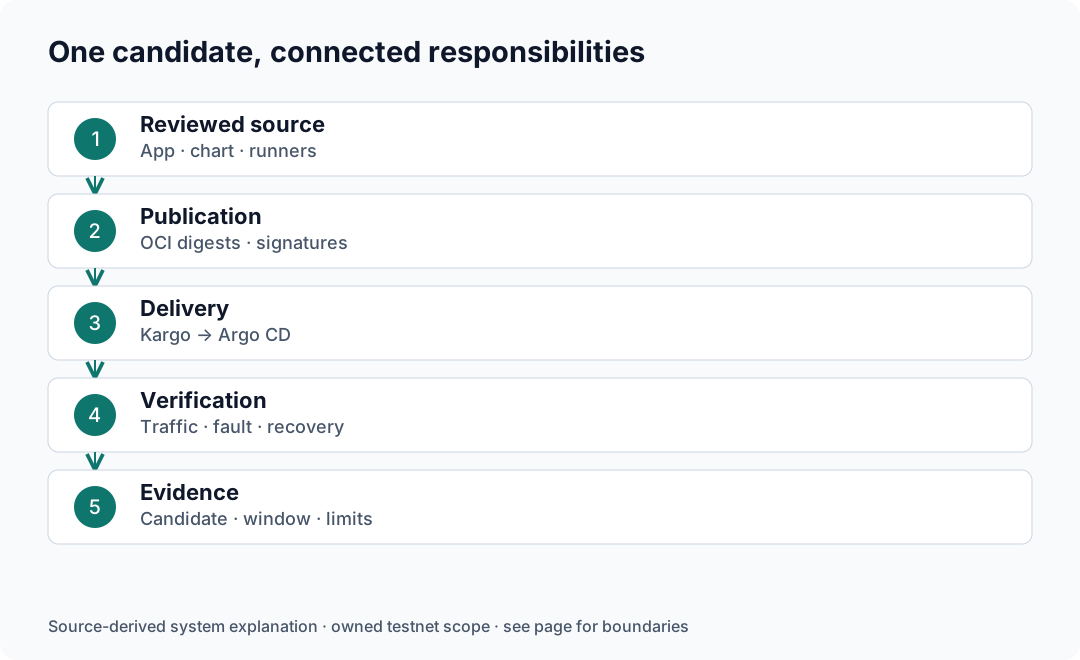
The client uses FastAPI for durable creation and redirects. PostgreSQL owns mappings; Redis accelerates established redirects with database fallback. The paid client obtains signer authorizations, while the application calls the facilitator for verification/settlement before persistence. CI publishes and signs selected image bytes. Kargo selects Freight/chart inputs and renders environment output; Argo CD reconciles it. The staging runner performs paid preflight, serial faults and cleanup, and the scorer consumes returned Prometheus evidence. Staging success grants normal eligibility; prod-like promotion remains explicit.
Source-derived explanation; not a live observation.app/main.py · app/payment.py · kubernetes/jobs/scripts/loadgen.js · .github/workflows/build-push.yaml · kubernetes/kargo/warehouse.yaml · kubernetes/kargo/stage-staging.yaml · kubernetes/apps/applicationset.yaml · kubernetes/chaos-experiments/orchestrate.sh · kubernetes/chaos-experiments/score_experiment.py · kubernetes/kargo/project.yaml
Follow the choices that make the result trustworthy: rejecting missing measurements, separating cleanup from scoring, and surviving cache loss without inventing a stronger dependency guarantee.
DECISION 01
How can an empty query avoid becoming a healthy zero?
Validate the returned samples and the query contract before applying a threshold.
Read the engineering caseDECISION 02
What if the experiment passes but cleanup fails?
Keep scoring, cleanup, Job outcome, AnalysisRun and eligibility as separate decisions.
Read the engineering caseDECISION 03
Why does Redis failure differ at runtime and startup?
Read durable mappings on a cache exception while preserving the stricter startup dependency.
Read the engineering caseExplore all five engineering cases, including controller ownership and the payment–database consistency boundary. Each case identifies source, tests, historical observations and what remains unproven.
Satyam Agnihotri
DevOps & Cloud Engineer · devSatym
I focus on Kubernetes, cloud infrastructure, and secure delivery workflows. This handbook explains how a release system works together, why its decisions were made, and what its bounded evidence demonstrates.
The full engineer profile and contribution boundaries distinguish source-backed implementation and test contributions from claims about sole original design or who personally ran a past campaign.
The retained records include a successful release and a deliberately blocked candidate. These are different campaigns with different identities. A later screenshot capture date never moves an earlier observation into the fresh release window.
Observation: 2026-10-03 · staging 14:37:29–14:46:28 UTC
The public verification report records paid preflight, three dependency faults, recovery and cleanup. Fresh raw bundles are privately retained; the screenshot is a reviewed supporting view.
Read the supporting recordObservation: 2026-10-02 · preflight 05:08:44–05:10:11 UTC
The historical negative candidate could not prove paid traffic within 75 seconds. Verification failed before injection. This result is independent of the October 3 release.
Read the supporting recordREVIEWED EVIDENCE / CAPTURE 11
The reviewed Kargo capture shows the fresh October 3 staging verification as Successful. It does not expose the privately retained raw metrics bundle.
Observed window: 2026-10-03 14:37:29 UTC–14:46:28 UTC
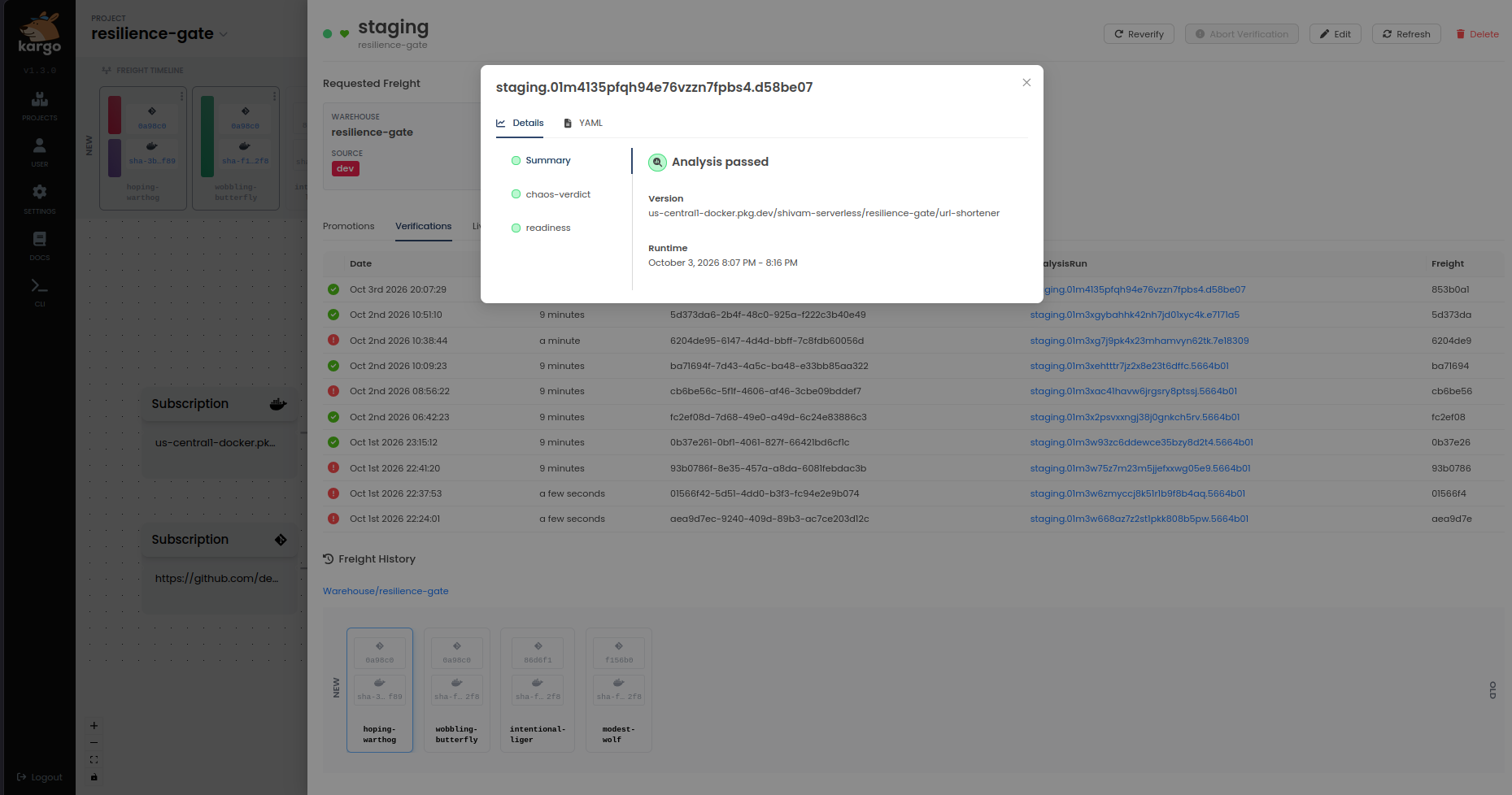
Original available · recorded screenshot · numerical verdict not assessed from pixels
ace8e91b625aa69414f756762f7f5cf3c005bcfe0e432e760c324caebe6eff83Inspect the negative-case capture and its identity, or browse all 34 original reviewed screenshots. The gallery keeps availability, observation role and verdict interpretation separate.
Database-dependent creation fails. A previously cached redirect may still succeed; that does not make the durable store optional.
OPTIONAL RUNTIME CACHERedis disappears.A warm application can fall back to PostgreSQL. Cold startup still has a stricter Redis dependency.
UPSTREAM PAYMENT CLIENTThe signer disappears.The load generator may stop before sending a paid request. Application metrics alone cannot describe that entire failure.
Learn what the application does, who owns deployment, and what verification establishes.
02 / FOLLOW THE HANDOFFSTrace one candidate.Follow publication, discovery, rendering, reconciliation, and downstream eligibility.
03 / WORK WITH THE PROJECTStart without credentials.Validate source and local contracts, then find the procedures for an owned lab.
Readiness establishes a starting condition. Injection establishes that a fault occurred. Measurements establish bounded behavior. Cleanup establishes a separate operational outcome. Normal staging verification grants downstream eligibility; an operator still requests prod-like promotion.
Learn why a green score can still be insufficient, or trace the payment settlement before database persistence.
Resilience Gate documents one owned Radius testnet lab. Environments share a cluster. prod means production-like testnet, with no claim of public-production availability, mainnet settlement, custody, disaster recovery or broad chaos coverage. The October 3 release, October 4 lab retirement, and later documentation/license publication are separate events.
Meet the engineer and read the contribution boundaries. Related work includes the GCP Security Architecture Handbook and Azure AKS GitOps Observability source.
Inspect the limitations, integrated system design, and website implementation report for the exact boundaries and verification state.
Maintained by Satyam Agnihotri · DevOps & Cloud Engineer